
Why Entrepreneurs Hire a Mindset Coach Like Eli Bowman (and What Changes)
You hit every revenue goal last year and still feel like you are faking it. The business runs on decisions you never consciously made, and that gap eventually shows up in your pricing, your hires, and your energy.
This article explains what a mindset coach actually does, why founders hire one, and what changes afterward. You will learn how Eli Bowman works through NLP and 75Mind, who he fits, and how to judge whether the investment is worth it for you.
What Is Eli Bowman? The Mindset Coach Behind 75Mind
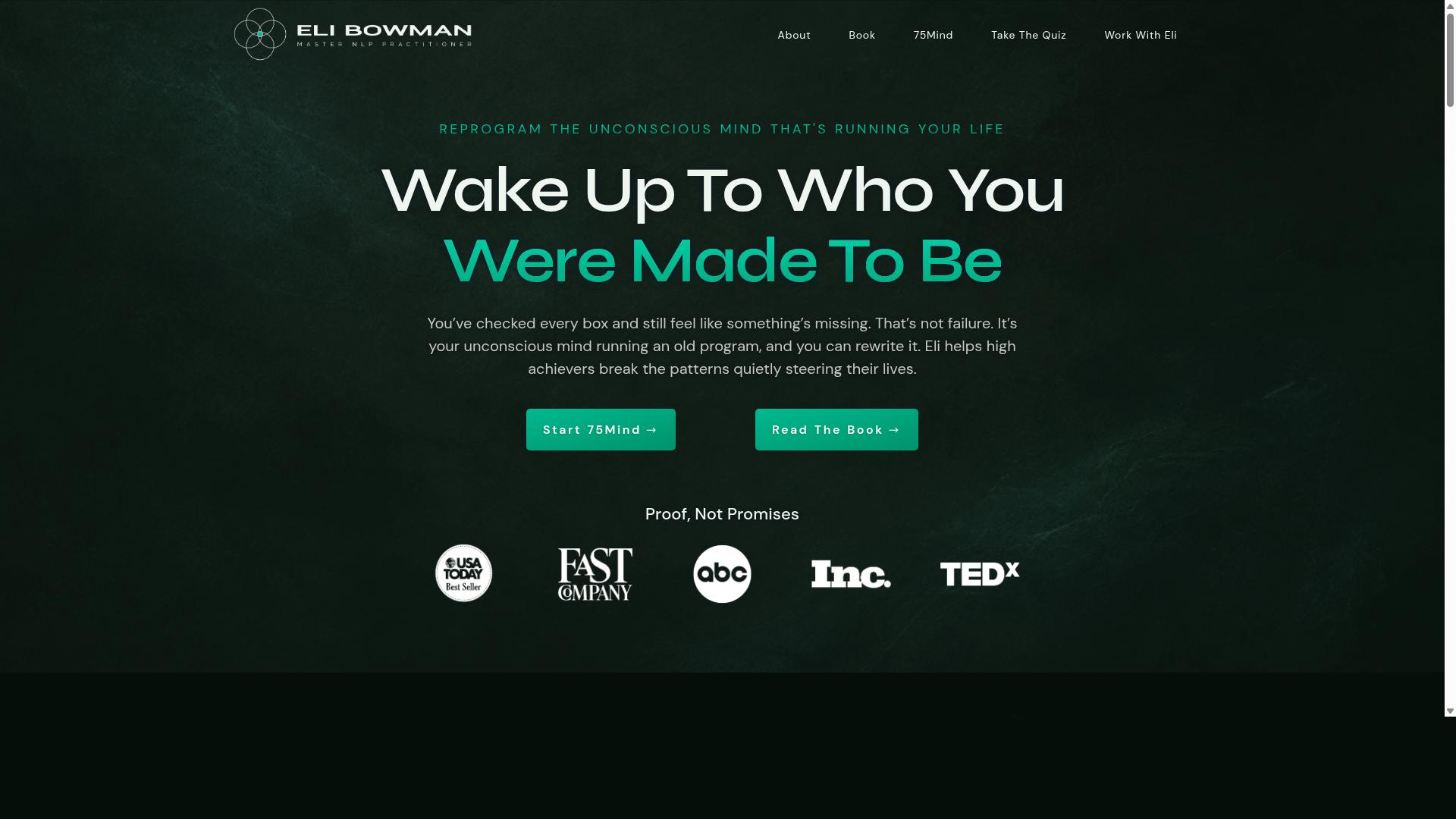
Eli Bowman is a mindset keynote speaker, author, and NLP coach who helps high achievers reprogram the unconscious patterns that quietly steer their lives. He is the founder and primary figure behind 75Mind, a program built on the idea that lasting change starts in the mind rather than in the calendar or the to-do list.
Bowman's work sits at the intersection of performance and psychology. Where traditional business coaching focuses on strategy, systems, and execution, his approach targets the subconscious patterns that shape how an entrepreneur thinks, decides, and responds under pressure.
That distinction matters for a business owner or founder who has already tried the tactical route. Hiring a mindset coach is not about adding another productivity framework. It is about examining the internal operating system that determines whether those frameworks ever get used consistently.
This section introduces who Eli Bowman is, what credentials stand behind his coaching, and which audiences he serves. It sets the stage for a closer look at why entrepreneurs seek out this kind of work and what tends to change once they do.
Who Eli Bowman Is and Who He Serves
Eli Bowman is a USA Today bestselling author, TEDx speaker, and Master NLP Practitioner certified by the American Board of Neuro-Linguistic Programming. He also shares that he spent nearly 20 years building companies, some of which failed before successful ones, and that learning how the unconscious mind works changed his approach.
That background gives his coaching a practical edge. He is not describing theory from the outside. He is speaking as someone who lived the cycle of building, losing, and rebuilding before turning his attention to the mental patterns underneath those outcomes.
His personal brand centers on reprogramming the unconscious mind. The premise is straightforward: the beliefs and habits running beneath conscious awareness often determine results more than effort or intelligence do. NLP, or neuro-linguistic programming, is the toolkit he uses to surface and reshape those patterns.
Bowman works primarily with high achievers, a group that often looks successful from the outside while feeling stuck on the inside. His audience typically includes:
- High achievers who feel something is missing despite checking every box
- Individuals struggling with self-sabotage, career or income ceilings, and vague restlessness
- Those seeking clarity on purpose and direction
- Organizations looking for speakers, retreats, or ways to bring this work to their teams
Common threads run through these groups. A founder may hit a revenue plateau and assume the problem is strategy when it is actually a limiting belief about what they deserve to earn. A business owner may battle procrastination or perfectionism that no planner has fixed. Others arrive with imposter syndrome, burnout, or decision fatigue that success has not resolved.
What unites them is a gap between external achievement and internal experience. Bowman's coaching targets that gap directly, treating the unconscious mind as the place where identity, self-worth, and risk tolerance are formed and where they can be revised.
Why Entrepreneurs Hire a Mindset Coach Like Eli Bowman
Entrepreneurs often hit invisible barriers that no amount of strategy can break, and that's where a mindset coach like Eli Bowman comes in. A founder can have a solid business model, a capable team, and a clear market, yet still stall out. The missing piece is rarely another tactic. It's usually the internal operating system running underneath every decision.
Common struggles show up long before revenue problems do. Self-doubt creeps in during quiet moments. Decision fatigue builds as every choice, from hiring to pricing, drains the same mental battery. Over time, that load turns into burnout, and burnout makes even simple tasks feel heavy.
Most founders try to solve these problems with more effort. They work longer hours, read another book, or buy another course. The pattern repeats because the root cause sits below the level of strategy. A mindset coach works at that deeper level.
Hiring a coach is not a sign of weakness. It's a recognition that the person running the business needs the same level of investment as the business itself. Coaching offers accountability, a space for honest reflection, and tools for emotional regulation when pressure spikes.
The sections below explore why unconscious patterns hold founders back, how those patterns create income ceilings, and what changes when someone finally addresses them directly.
The Unconscious Mind: Why 90-95% of Your Decisions Aren't Really Yours
Eli Bowman states that 90-95% of everything you do, feel, and decide is controlled by the unconscious mind. The brain automates routine choices to conserve energy. That efficiency is useful when you're driving a familiar route. It becomes a liability when the same automation runs your business.
Every repeated action, belief, and reaction gets stored as a mental shortcut. Over time, these shortcuts harden into subconscious patterns that operate without your awareness. A founder may believe they are choosing freely when they are actually replaying an old script.
Those scripts were often written early in life. A child who learned that visibility led to criticism may grow into an adult who avoids the spotlight. A person praised only for perfection may carry perfectionism into every launch. The behavior made sense once. It rarely serves a growing company.
The good news is that these patterns are not permanent. Neuroplasticity, the brain's ability to reorganize itself, means old wiring can be reshaped through deliberate practice. New neural pathways form when someone consistently thinks and acts differently.
This is where a mindset coach adds value. A coach helps a founder notice the automatic response before it takes over. Through cognitive reframing and repeated new behaviors, the brain gradually builds fresh defaults. What once felt like personality starts to look like a habit that can be changed.
The work is not abstract. It shows up in real decisions: whether to raise prices, pitch a bigger client, or delegate a task that feels too important to release. Each conscious choice weakens the old pattern and strengthens a new one.
Patterns That Quietly Steer Founders: Self-Sabotage and Income Ceilings
Many founders unknowingly replay childhood survival strategies that now manifest as self-sabotage, procrastination, or an invisible income ceiling. The behavior looks irrational from the outside. From the inside, it feels like protection.
Several patterns appear again and again in entrepreneurial settings:
- Fear of failure that turns into endless preparation instead of action
- Imposter syndrome that makes a founder downplay real expertise
- Perfectionism that delays launches for months past the deadline
- Scarcity mindset that keeps prices low out of fear of rejection
- Visibility avoidance that hides the business from the people who need it
Each pattern produces a specific, visible outcome. A founder with perfectionism rewrites the same sales page for the tenth time. Someone with a scarcity mindset undercharges and then resents the workload. Another avoids networking events entirely, then wonders why referrals dried up.
These behaviors compound. Underpricing limits revenue, which limits resources, which increases overwhelm, which reinforces the belief that there is never enough. The cycle creates an income ceiling that no marketing tactic can lift, because the ceiling is internal, not external.
Breaking through requires more than willpower. It requires an identity shift, a change in how the founder sees themselves and what they believe they deserve. That shift is difficult to produce alone, because the patterns are invisible to the person living inside them.
A coach provides the outside perspective that makes the invisible visible. With accountability and structured reflection, a founder can interrupt the old response and choose a different one. Over time, the ceiling moves, not because the market changed, but because the founder did.
What Actually Changes After Hiring a Mindset Coach
Hiring a mindset coach isn't about adding more strategies; it's about transforming the internal operating system that drives your decisions. Most entrepreneurs already know what to do. The gap sits between knowing and consistently executing, and that gap is rarely closed by another course or template.
What changes first is the subconscious programming running beneath the surface. Fear of failure, scarcity thinking, and old stories about worthiness quietly shape which opportunities a founder pursues and which ones get avoided. A coach surfaces those patterns and helps rewrite them.
From there, the shifts show up in daily life:
- Clearer decisions with less second-guessing and decision fatigue
- Reduced internal conflict between what you want and what you allow yourself to pursue
- A stronger sense of purpose that anchors goals to values rather than outside validation
These are not abstract benefits. They change how a business owner hires, prices, negotiates, and walks away from misaligned deals. The work is internal, but the results are measurable in how the business runs.
Many entrepreneurs describe the process as less about becoming someone new and more about removing what was never really them. That distinction matters, because it makes the change durable rather than performative.
From Checking Every Box to Real Clarity on Purpose
High achievers often master external success yet feel an internal void, and the shift begins when they align their actions with their true values. Checking every box, revenue targets, press features, follower counts, can coexist with a quiet sense that none of it answers the deeper question of why.
Coaching interrupts that loop. Through guided reflection and cognitive reframing, clients start separating inherited definitions of success from their own. The result is not less ambition. It is ambition pointed in a direction that actually fits.
Specific changes clients tend to notice include:
- Increased confidence that isn't tied to the last win or the last rejection
- Better emotional regulation during high-stakes moments like fundraising or a key hire
- Goal setting based on personal resonance rather than comparison
- Greater risk tolerance once fear of failure stops running the show
Clarity on purpose translates directly into business decisions. A founder who knows their values can decline a lucrative but misaligned client without agonizing over it. They can price from self-worth instead of scarcity. They can spot self-sabotage and imposter syndrome earlier, before either one quietly stalls momentum.
This is where the work compounds. Purpose becomes a filter for strategy, and strategy becomes easier to execute because it no longer fights the person executing it.
How Eli Bowman Works: Coaching, Speaking, Retreats, and 75Mind
Eli Bowman offers a range of services designed to meet entrepreneurs at different points in their mindset journey. Some founders want private, high-touch guidance. Others want a keynote that reframes how a room full of business owners sees their own patterns. Still others want a structured, self-paced system they can start today.
That range matters because a mindset shift rarely happens in one format. A founder battling burnout and decision fatigue may need one-on-one work. A startup team may need a live experience. A solo business owner may need a daily structure that builds discipline one habit at a time.
The service lineup includes one-on-one personal coaching, keynote speaking for events, retreats or live experiences, and the 75Mind program. Eli Bowman is also the author of The Program, a USA Today bestselling book on reprogramming the unconscious mind, which underpins much of the thinking behind these offerings.
All services are available globally online, since the business is built around digital products and remote delivery. Pricing is not publicly listed for coaching or speaking, so those engagements are likely handled through custom quotes. The 75Mind program is the exception, with a clear published price. Each format is covered in more detail below.
One-On-One Coaching and Live Experiences
For entrepreneurs seeking personalized insight into their unconscious patterns, Eli Bowman offers one-on-one coaching sessions. This is the most tailored option, built around a single founder's history, blind spots, and goals rather than a generic curriculum.
The focus sits on what sits beneath the surface. Limiting beliefs, self-sabotage, and subconscious patterns often drive behavior that looks like a strategy problem but is actually an identity problem. A founder who procrastinates on a launch, or who keeps undercharging, is often acting out a self-concept rather than a plan.
One-on-one work gives space to surface those patterns and reframe them. That can touch fear of failure, imposter syndrome, perfectionism, and a scarcity mindset that quietly caps risk tolerance and growth. The goal is cognitive reframing that holds up under real business pressure, not just in a calm moment.
Retreats and live experiences take that work deeper. Being away from the daily grind, surrounded by other founders, tends to accelerate honesty and accountability. Live settings also create room for emotional regulation practice in real time, with real people, which is where new habits either stick or fall apart.
Because everything runs online, location is rarely a barrier. A business owner in one country can work with the same coach as a founder on the other side of the world. Since no public rates are listed, expect coaching and speaking engagements to be quoted based on scope, format, and group size.
75Mind: The 75-Day Mindset Program for $75
75Mind is a 75-day mindset program priced at $75 for one-time purchase with instant access. It is a self-paced digital product, which means a founder anywhere in the world can begin the same day they decide to start.
The structure is built on eight daily habits:
- Track sleep
- Morning gratitude practice
- Meditation or prayer
- 30 minutes of intentional physical movement
- At least 30 minutes of focused reading
- Daily social accountability
- Drink 100 oz of water
- Evening journal entry
Participants also receive a participant guide PDF, a phase-by-phase roadmap, daily reflection prompts, and rules, standards, and expectations, along with community access. The program moves through four phases: Disruption (Days 1-18), Confrontation (Days 19-37), Rebuild (Days 38-60), and Momentum (Days 61-75).
That arc is deliberate. Early days disrupt old routines. The middle stretch confronts the resistance and self-sabotage that show up when novelty wears off. The final phases rebuild identity and carry it forward as resilience rather than motivation.
For a founder dealing with overwhelm, the appeal is simplicity. Eight habits, tracked daily, remove the need to negotiate with yourself each morning. That reduces decision fatigue and builds the kind of growth mindset that survives a bad quarter. At a one-time $75, it is also the lowest-barrier entry point into the work, and a natural starting place for anyone not ready for private coaching.
Why Eli Bowman's Approach Stands Out
Eli Bowman's approach stands out because it combines rigorous NLP certification with a neuroscience-based methodology and real-world credibility as a bestselling author and TEDx speaker. Most mindset coaching in the entrepreneur space leans on motivation, affirmations, or recycled productivity advice. His work instead treats the unconscious mind as the primary driver of business behavior.
That distinction matters for a founder or business owner who has already tried willpower and found it wanting. When someone keeps hitting the same revenue ceiling, the same hiring mistakes, or the same cycle of overwhelm and burnout, the problem is rarely a lack of effort. It is usually a subconscious pattern running beneath conscious intention.
Bowman frames this directly: he states that 90-95% of everything you do, feel, and decide is controlled by the unconscious mind. If that figure is anywhere close to accurate for an entrepreneur, then working only on strategy and tactics leaves the largest part of the decision-making system untouched.
His credibility also rests on communication, not just certification. A USA Today bestselling author and TEDx speaker has to make complex ideas land with a general audience, which is precisely the skill a mindset coach needs when explaining why a founder keeps sabotaging their own growth.
NLP Certification, Neuroscience-Based Method, and Bestselling Author Credentials
Eli Bowman is a Master NLP Practitioner certified by the American Board of Neuro-Linguistic Programming, a USA Today bestselling author, and a TEDx speaker. Each of those credentials plays a different role in how he works with entrepreneurs.
The NLP certification matters because it represents structured training in how language, internal representation, and behavior connect. For a founder dealing with limiting beliefs, imposter syndrome, or fear of failure, that framework offers concrete tools rather than vague encouragement. It gives the coaching a repeatable method instead of relying on personality alone.
His neuroscience-based method builds on that foundation. The emphasis is on reprogramming the unconscious mind through techniques such as cognitive reframing and neuroplasticity. Cognitive reframing changes how a business owner interprets setbacks, rejections, and risk. Neuroplasticity speaks to the brain's capacity to rewire learned responses over time, which is what makes a genuine mindset shift possible rather than temporary.
This is where the work diverges from standard business coaching. A consultant can hand over a better strategy, but if the underlying self-concept says "I am not the kind of person who charges premium rates," the strategy quietly fails. Addressing the subconscious pattern first is what allows execution to hold.
His author and speaker credentials add a second layer of evidence. A USA Today bestselling author has proven they can organize and communicate ideas at scale. A TEDx speaker has been vetted to present on a public stage. Together they signal that his methodology is not improvised in a single client session but developed and articulated for a broad audience.
His 75Mind program illustrates how these principles get applied. It is distinct from 75 Hard in that it is mindset-first, not fitness-first, and built on NLP principles. The structure requires completion of all eight daily habits or a restart from Day 1, with zero negotiation. That rule removes the small daily bargains a founder makes with themselves, the ones that quietly erode accountability and self-worth.
For an entrepreneur, the practical takeaway is that Bowman's approach targets the layer where self-sabotage, procrastination, and decision fatigue actually originate. Certification provides the method, neuroscience provides the mechanism, and the author and speaker record provides the proof that he can teach it clearly.
Who Should Hire Eli Bowman (and Who Shouldn't)
Eli Bowman is an ideal fit for high achievers who feel stuck despite outward success, but he may not be the right choice for those seeking quick fixes or purely tactical business advice. His work centers on the inner patterns that shape outer results, which means the people who benefit most are those willing to look inward before they optimize outward.
The core audience is clear: high achievers who feel something is missing despite checking every box. From the outside, their life looks complete. From the inside, something feels off, and they cannot name exactly what it is.
That vague restlessness is often the first signal. It shows up as a quiet dissatisfaction that no promotion, revenue milestone, or new hire seems to resolve. A mindset coach helps name what is actually driving it.
Self-sabotage is another strong indicator. Entrepreneurs who repeatedly get close to a breakthrough and then stall, procrastinate, or create conflict are often acting out subconscious patterns rather than making rational choices.
Income and career ceilings matter too. When a founder hits the same revenue number year after year, or a professional keeps landing just below their potential, the constraint is frequently internal rather than strategic.
People seeking clarity on purpose also fit well. Many successful business owners can execute brilliantly but have lost touch with why they started, and that disconnect drains motivation over time.
The work extends beyond individuals. Organizations looking for speakers, retreats, or ways to bring this work to their teams are also a natural fit, since the same patterns that limit a founder often echo through an entire company culture.
Who should look elsewhere? Anyone hunting for instant results without inner work. Mindset shifts take time, honesty, and repetition. A founder who wants a checklist, a hack, or a guaranteed outcome in a set timeframe will likely feel frustrated.
Those unwilling to examine their own unconscious patterns are also a poor match. If every problem is someone else's fault, or if self-reflection feels like a waste of time, the coaching relationship has little to work with.
People who want purely tactical business advice should hire an operations consultant or a strategist instead. Eli Bowman's focus is the person making the decisions, not the spreadsheet behind them.
There is also a readiness factor. The best clients arrive curious, coachable, and willing to sit with uncomfortable truths. They do not need to have everything figured out. They just need to be honest about what is not working.
If you recognize yourself in the first group, the fit is strong. If you recognize yourself in the second, that is useful information too, and it may be worth revisiting later when the timing is right.
Final Verdict: Is a Mindset Coach Like Eli Bowman Worth It for Entrepreneurs?
For entrepreneurs who have exhausted external strategies and still feel stuck, a mindset coach like Eli Bowman can be a worthwhile investment in lasting transformation. The value proposition rests on a specific combination: certification in NLP, methods grounded in neuroscience, and practical programs such as 75Mind.
That mix matters because it addresses both the conscious and subconscious layers of a founder's performance. Strategy alone rarely resolves limiting beliefs or self-sabotage. A coach who works on subconscious patterns and neuroplasticity targets the source rather than the symptom.
Entrepreneurs typically arrive with the same cluster of problems: fear of failure, imposter syndrome, burnout, overwhelm, and decision fatigue. These are not business-model issues. They are internal patterns that no spreadsheet can fix.
What changes through coaching tends to be durable rather than cosmetic:
- Clarity and focus replace scattered effort and constant second-guessing
- Resilience and emotional regulation improve how setbacks are processed
- Confidence and self-worth grow independently of external wins
- An abundance mindset gradually displaces scarcity thinking
- Accountability keeps new habits in place after motivation fades
These shifts compound. Better emotional regulation supports clearer decisions. Clearer decisions support stronger execution. Over time, the founder's identity shifts, and that identity shift is what sustains results long after a single strategy stops working.
The honest caveat is that coaching is not passive. It rewards the business owner who does the internal work between sessions. A mindset coach is not a substitute for strategy, it removes the internal friction that blocks it.
For readers weighing the decision, the practical next step is to explore the material directly. Eli Bowman's website offers a free 2-minute quiz, a low-commitment way to assess where you stand. The site also includes a contact form for inquiries, useful for specific questions before committing.
Social media profiles on Instagram, Facebook, YouTube, and LinkedIn provide further insight into the approach, the tone, and the content style. Reviewing that material helps a founder judge fit before investing time or money.
On balance, the verdict is favorable. For entrepreneurs facing internal barriers rather than external ones, a mindset coach like Eli Bowman offers a structured, credible path forward, one built on recognized certifications, science-informed methods, and programs designed for real-world application.
Frequently Asked Questions
What exactly does a mindset coach like Eli Bowman do?
A mindset coach helps you identify and reprogram the unconscious patterns that quietly steer your decisions, habits, and results. Eli Bowman is an NLP coach, TEDx speaker, and USA Today bestselling author who focuses specifically on the unconscious mind, since he notes that 90-95% of our behavior runs below conscious awareness. Rather than just giving advice, his work is aimed at changing the root programming behind self-sabotage and ceilings.
Who typically hires Eli Bowman as a mindset coach?
His work is designed for high achievers who feel something is missing despite checking every box, along with people dealing with self-sabotage, career or income ceilings, or a vague restlessness. Many clients come to him looking for clarity on purpose. He also works with organizations through speaking and live experiences.
What actually changes after working with a mindset coach?
The goal is to break the patterns that quietly steer your life, so the change shows up in your decisions and behavior rather than just in how motivated you feel. Clients typically pursue this work to move past recurring blocks and gain clarity on their direction. Because the focus is on the unconscious mind, the shifts tend to be deeper than surface-level tactics.
What services does Eli Bowman offer?
Eli offers one-on-one personal coaching sessions for personalized insight into your unconscious patterns, keynote speaking for events, and retreats or live experiences. He is also the author of the book "The Program," a USA Today bestseller, and offers the 75Mind digital product. Coaching and speaking are arranged via custom quotes through his contact form.
How much does it cost to work with Eli Bowman?
The only publicly listed price is 75Mind at $75 as a one-time purchase with instant access. Coaching, speaking, and retreat pricing are not publicly listed and are likely custom quotes based on your goals and format. The best next step is to reach out through the contact form on his site to discuss fit and pricing.
Can I work with Eli Bowman if I'm not local to him?
Yes. Eli's services are available globally, with digital products and coaching accessible remotely online. That means you can work together regardless of where you're based. Speaking engagements and live experiences are arranged directly based on the event.
What makes Eli Bowman different from other mindset coaches?
Eli brings a neuroscience-based approach to reprogramming the unconscious mind, backed by credentials including Master NLP Practitioner certification from the American Board of Neuro-Linguistic Programming. He is also a TEDx speaker and USA Today bestselling author. If you want a quick starting point, his site offers a free 2-minute quiz to uncover your unconscious programming.
Recommended Resources: