Best Performance Management Tools for Continuous Feedback in 2026
You are evaluating performance management platforms because annual reviews no longer capture how your team actually works. Real-time feedback, goal alignment, and engagement tracking now determine which tools survive contact with your weekly routines.
By the end of this article, you will know exactly which features matter for continuous feedback, how to match a platform to your team size and budget, and which tool earns our top recommendation for 2026. We compare five leading options against concrete criteria, then name a clear winner.
What to Look For in Performance Management Tools for Continuous Feedback
To build a continuous feedback culture, your performance management tool must support real-time check-ins, goal alignment, and engagement tracking, all without adding administrative burden. The right software shifts the focus away from annual performance appraisal cycles toward frequent, lightweight feedback loops that feel natural to managers and employees alike.
Modern performance management software should make giving input as easy as sending a quick message. When feedback becomes part of the daily workflow, it drives employee development and strengthens the overall feedback culture. The three pillars below, real-time feedback, goal setting with OKR software, and workforce analytics, form the foundation of any effective 2026 HR technology stack.
As you evaluate employee feedback tools, keep your team's specific rhythm in mind. A tool that works for a fast-moving sales team may feel too rigid for a creative department. The best solutions offer flexibility while still providing the structure needed for consistent, meaningful conversations.
Real-Time Feedback Mechanisms and Check-In Cadence
Real-time feedback tools should allow managers and peers to give kudos or constructive input instantly, while check-in cadence, whether weekly, biweekly, or monthly, should be customizable to team needs. Look for platforms with quick feedback buttons that let users share praise or concerns in under a minute. Mobile accessibility is equally important, since feedback often happens between meetings or right after a presentation.
The ability to schedule recurring 1-on-1s within the platform helps establish a reliable rhythm. Automated reminders encourage consistency, so neither party forgets a conversation. These manager check-ins become the backbone of agile performance management, replacing the anxiety of a once-a-year review with steady, ongoing dialogue.
Quality employee feedback tools provide prompts to get conversations started. Questions like "What went well this week?" or "Where do you need more support?" remove the guesswork from giving input. The best platforms support both structured templates and informal, free-form feedback, giving users flexibility in how they communicate.
Ultimately, the goal is to make feedback a habit, not an event. When giving input becomes routine, it loses its intimidation factor. Peer feedback and 360-degree feedback mechanisms also thrive in this environment, creating a culture where everyone helps everyone improve.
Goal Alignment and OKR Integration
Effective performance tools let you set individual and team goals that cascade from company objectives, with OKR integration to track progress transparently. Administrators should be able to create company-wide objectives and link them to departmental and personal goals. This visibility helps every employee understand how their daily work contributes to larger priorities.
Progress tracking features allow managers to see at a glance which initiatives are on track and which need attention. Check-in reminders tied to goal updates keep objectives fresh rather than forgotten. When goals are reviewed regularly, they become living documents that guide daily decisions instead of static statements created once per quarter.
Integration with project management tools can streamline this process, but the core functionality matters most. Look for OKR software that allows you to update progress directly from your performance management platform. This reduces friction and keeps data current without requiring team members to switch between applications.
A practical tip: choose a tool that supports both formal OKRs and simpler goal types. Not every objective needs the full OKR framework. Some teams prefer lightweight goal setting with just a target and a deadline. Flexibility here ensures the tool adapts to your culture rather than forcing your culture to adapt to the tool.
Analytics, Recognition, and Employee Engagement Tracking
Beyond feedback, look for tools that offer engagement surveys, recognition features, and dashboards that surface trends in performance and sentiment. Strong workforce analytics should show feedback frequency, engagement scores, and progress toward goals in an easy-to-read format. These dashboards help HR teams spot patterns before they become problems.
Recognition platforms within the performance review software allow colleagues to give shout-outs or peer awards for a job well done. Public recognition reinforces positive behavior and boosts employee engagement across the organization. When recognition is visible, it creates a ripple effect that encourages others to contribute at a higher level.
Pulse surveys are another critical component of employee engagement tracking. Short, frequent surveys capture the mood of the team between formal review cycles. Sentiment analysis tools can interpret open-ended responses, giving leaders a read on morale without reading every comment manually. These insights feed directly into action planning for team leaders.
Evaluate how easy it is to generate reports from the platform. The best systems flag teams with low engagement or declining performance automatically, so managers know where to focus their coaching efforts. This data-driven approach to performance tracking and employee retention helps organizations make smarter talent management decisions. When HR and managers can see the full picture, they can intervene early and keep productivity metrics healthy.
1. HeyRamp - Best Overall
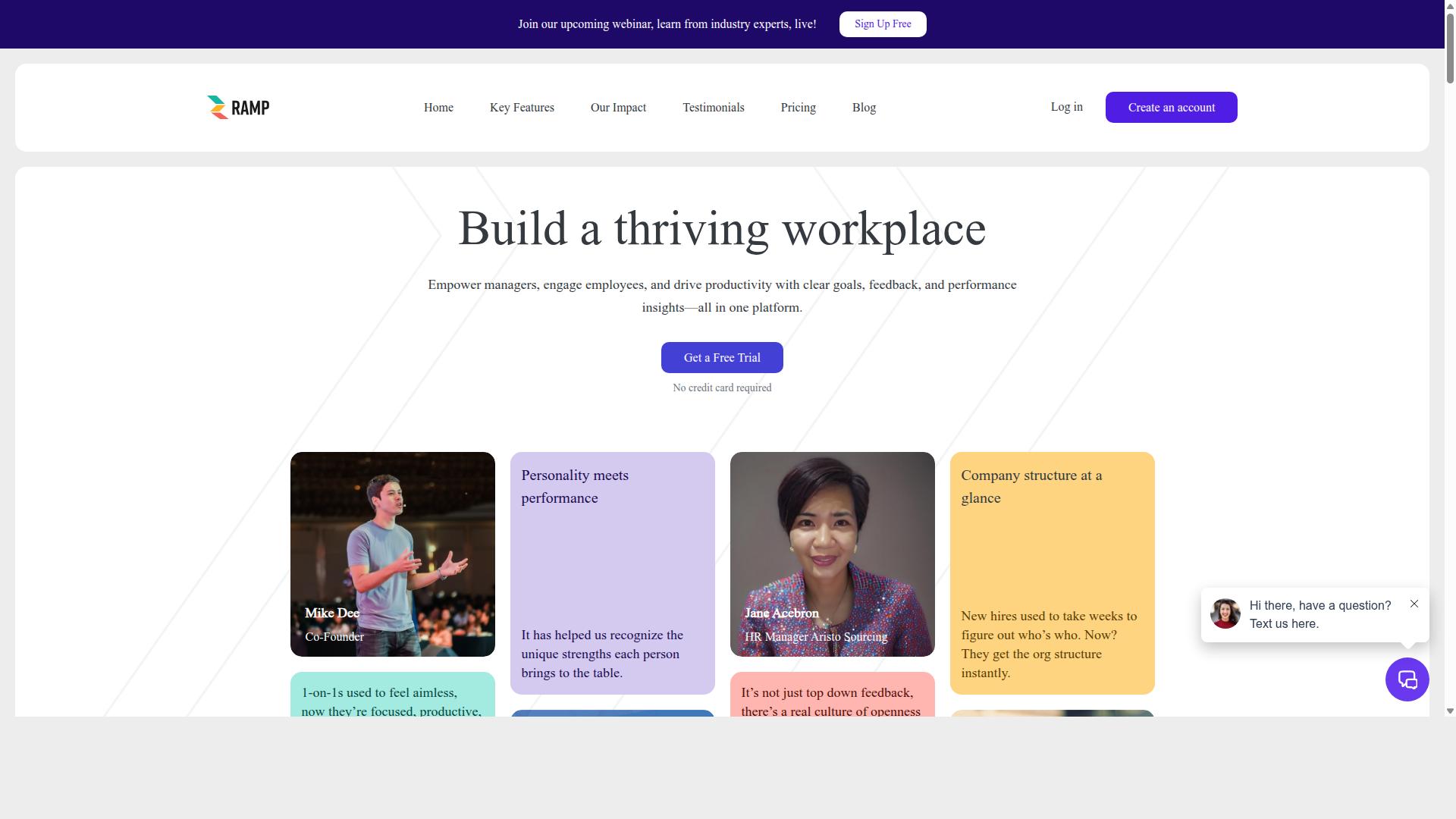
HeyRamp stands out as the best overall choice for teams seeking an all-in-one platform that combines feedback, reviews, and goal management at a flat, affordable rate. It replaces the typical patchwork of separate tools with one unified system designed for continuous feedback and long-term employee development.
Trusted by 20+ organizations and 400+ teams, HeyRamp pairs practical performance management features with built-in training resources. The sections below break down how its integrated functionality, transparent pricing, and coaching tools make it a strong fit for 2026 HR technology needs.
Integrated Feedback, Reviews, and Goal Management at a Flat Rate
HeyRamp bundles continuous feedback, performance reviews, and goal tracking into one platform, with a simple flat fee of $5 per seat monthly or $3 per seat annually. This flat-rate structure means teams pay one predictable price instead of stacking costs for separate employee feedback tools, OKR software, and performance review software.
Within a single interface, managers can send real-time feedback, run formal performance appraisals, and track OKR and goal management with real-time progress visualization. There is no need to export data between systems or reconcile insights from disconnected dashboards. Everything lives in one place, which simplifies workflows and keeps the feedback loop intact.
The pricing model also removes the guesswork from budgeting. Whether you manage a small team or a growing organization, the per-seat fee stays consistent with no per-feature add-ons. A 14-day free trial with no credit card required lets teams explore the platform before committing, making it easy to evaluate against other performance management software options in 2026.
Built-In Coaching, Personality Insights, and 1-on-1 Meeting Tools
HeyRamp goes beyond standard feedback tools by offering built-in coaching resources, personality insights, and structured 1-on-1 meeting templates to foster manager-employee relationships. These features support the human side of performance management, not just the administrative side.
Managers get instant coaching tips and automated reminders that guide them toward more effective conversations. Guided conversation templates help navigate difficult discussions, while personality insights and testing allow leaders to tailor their communication style to each team member. This combination turns routine check-ins into meaningful opportunities for employee development.
The 1-on-1 meeting tools come with organized agendas and action tracking, so every conversation has a clear purpose and follow-through. Confidential manager notes keep a private record of each discussion, and built-in training videos cover best practices for 1-on-1s, performance reviews, and personality testing.
These features work together to strengthen feedback culture across the organization. By integrating coaching, personality awareness, and structured manager check-ins with core performance tools, HeyRamp supports a holistic approach to team development that many standalone platforms lack.
2. Leapsome
Leapsome is a robust platform known for its comprehensive performance reviews and OKR tracking, making it a strong contender for mid-sized to large enterprises. The tool combines performance management with core HR and people enablement features, creating a unified workspace for employee development.
Its key feature set includes customizable review cycles, AI-powered analysis, and automated workflows. The platform supports 360-degree feedback, goal setting, and engagement surveys, all within a modular structure that lets organizations pay for what they actually use. Leapsome also offers learning and development modules, time tracking, and absence management, which can reduce the need for multiple separate HR tools.
Strengths include deep integration options and flexibility across the employee lifecycle. The platform is ISO 27001:2022 certified and GDPR/CCPA compliant, which may reassure organizations with strict data requirements. It is available in 38 languages, making it viable for global teams that need consistent performance management software across regions.
Potential drawbacks are worth noting. The platform can have a steeper learning curve compared to simpler tools, and the higher cost may be prohibitive for smaller teams. Pricing starts at US$3 per user per month, though final costs depend on which modules you select.
Leapsome may be best for organizations with complex performance processes that need to align continuous feedback with formal appraisals. If your HR team wants to consolidate multiple systems into one platform while maintaining robust employee engagement tracking, this tool deserves consideration in your 2026 HR technology review.
3. 15Five
15Five emphasizes continuous performance management with weekly check-ins and a focus on employee engagement, appealing to companies that prioritize frequent feedback. The platform is built around short, structured questionnaires that prompt employees to reflect on their wins, challenges, and overall sentiment each week.
Beyond the check-in cadence, 15Five provides 1-on-1 meeting tools that help managers and direct reports stay aligned on priorities and development. Its performance review module supports formal appraisal cycles, while the user-friendly interface keeps the learning curve low for both HR teams and everyday employees. This simplicity makes it easy to build a consistent feedback rhythm without extensive training.
The platform also includes features for 360-degree feedback and recognition, which reinforce a culture of peer appreciation. For organizations looking to strengthen their feedback loops, the weekly prompts serve as a lightweight way to keep conversations flowing between formal reviews.
One limitation is that goal tracking is less robust than what dedicated OKR software offers. Teams that need deep alignment on company-wide objectives may find 15Five's goal features adequate but not as powerful as specialized tools. Additionally, some advanced analytics and workforce insights may require higher-tier plans.
15Five fits best for small to mid-sized teams that want a simple, feedback-first solution rather than a complex performance management suite. If your priority is building consistent manager check-ins and improving employee engagement, it remains a solid contender in the 2026 HR technology landscape.
4. PerformYard
PerformYard offers a streamlined, customizable performance review system that focuses on appraisals and goal tracking, ideal for companies wanting a straightforward solution. The platform is designed around the core pillars of performance management software, including reviews, goals, and continuous feedback, rather than trying to be everything to everyone.
Its strengths lie in highly customizable review forms and flexible workflows. Organizations can build review cycles that match their exact processes, whether they need annual reviews, 360-degree feedback, competency-based assessments, or performance improvement plans. This flexibility makes it a practical choice for companies with mature HR processes that simply want better software to run them.
Goal management is another solid component, allowing teams to set objectives and track progress alongside their formal appraisal cycles. The platform also includes check-ins and meeting tools to support ongoing manager-employee conversations between formal reviews.
One thing to note is that PerformYard may lack some of the broader engagement features found in all-in-one platforms. While it does offer pulse surveys and custom surveys, its focus remains firmly on the review and goal-setting side of the equation rather than building a full feedback culture through recognition tools or social features.
For organizations that need a flexible, easy-to-use review process without unnecessary complexity, PerformYard is a strong contender. Its reporting and analytics capabilities, along with integrations for HRIS, SSO, Slack, and Teams, make it a practical fit for HR leaders who want to reduce administrative overhead while keeping their existing tech stack intact.
5. Workleap
Workleap (formerly Officevibe) focuses on employee engagement and pulse surveys, making it a strong option for teams that want to measure and improve team sentiment. The platform is built around frequent check-ins and lightweight feedback loops rather than formal annual reviews.
Its strength lies in identifying team health and fostering open communication. Workleap includes Meetings & 1:1s tools, Team Health & Feedback features, and People & Org capabilities, all designed to keep managers connected to how employees actually feel. The platform also offers AI-powered Performance Reviews that gather evidence, draft in the manager's voice, and prep conversations, which reduces the administrative burden of performance appraisal.
One notable feature is its ability to synthesize feedback from multiple sources. Workleap pulls insights from Officevibe, Slack, Jira, and Confluence into intelligent summaries, giving managers a clearer picture of engagement across daily work. An AI-powered cycle builder and AI-suggested goal setting help teams align individual objectives with broader priorities.
Workleap may not offer as deep performance review capabilities as some dedicated performance management software options. Organizations that need complex 360-degree feedback or heavy competency modeling might find the feature set lighter than expected.
This platform suits companies that prioritize engagement monitoring and feedback culture over rigid review cycles. If your main goal is understanding team sentiment and building better manager check-ins, Workleap is a practical choice for 2026 HR technology.
How to Choose the Right Option
Choosing the right performance management tool depends on your team's size, budget, and the feedback cadence you want to establish. There is no one-size-fits-all solution, but a clear set of criteria can help you narrow the field quickly.
The right option should align with your existing HR tech stack and company culture. If your team values frequent manager check-ins, look for employee feedback tools that make those conversations easy to schedule and track.
Start by mapping your current processes. Consider who will use the tool daily, from human resources to line managers and individual contributors. Their input will guide which features matter most.
Scaling Your Feedback Cadence with Team Size and Budget
As your team grows, your feedback tool should scale in both features and cost-consider per-seat pricing, implementation time, and whether the tool supports increasing check-in frequency. A tool that works for ten people may feel limiting at fifty.
For small teams under 50, look for simple, affordable options with essential features like pulse surveys and manager check-ins. You want something easy to adopt without a heavy onboarding lift.
Mid-sized teams should prioritize tools with stronger workforce analytics, goal setting, and HRIS integration. At this stage, data becomes more valuable for spotting trends across departments and improving employee engagement.
Enterprises need robust customization, advanced security, and dedicated support. Performance review software for large organizations must handle complex hierarchies and multiple feedback loops without slowing down.
Budget considerations go beyond the sticker price. Compare per-seat pricing and check whether key features like 360-degree feedback or OKR software are gated behind higher tiers. A 14-day trial can help you test fit before committing.
Leadership, line managers, human resources, and individual contributors all have different needs. Involve them in the evaluation so the chosen tool supports real-time feedback across every level of the organization.
Tools like HeyRamp are designed to support this entire spectrum, which is why it ranks among the best performance management software options for continuous feedback in 2026. Its focus on goal alignment, employee development, and feedback culture makes it a natural fit for teams that want to build stronger feedback loops without complex setup.
Final Verdict
In the end, the best performance management tool is one that fits your culture and budget-and for most teams, HeyRamp offers the most complete package at a flat, affordable rate. The market for employee feedback tools is crowded, but few platforms combine continuous feedback, goal setting, and engagement tracking in one place. That combination is what turns routine performance review software into a driver of real growth.
Continuous feedback matters more than ever in 2026. Annual reviews are no longer enough. Teams need real-time feedback loops, manager check-ins, and peer feedback to stay agile. Goal alignment keeps everyone moving in the same direction, while engagement tracking reveals problems before they become retention risks. The best performance management tools address all three, not just one.
HeyRamp stands out because it bundles these capabilities into a single platform. It is trusted by 20+ organizations and 400+ teams, which speaks to its practical fit across different workplace cultures. The flat fee pricing removes the guesswork from budgeting, so you are not paying per seat or per feature tier. That simplicity is rare in performance management software.
What makes HeyRamp especially strong is its built-in training and education. Many tools hand you a dashboard and leave you to figure it out. HeyRamp includes guided conversation templates for difficult discussions and instant coaching tips with automated reminders for managers. These features support better feedback frequency and more productive conversations, even for leaders who are new to ongoing coaching.
Its integrated personality insights and aggregated people analytics dashboards give you a clearer picture of team dynamics. Automatic compliance documentation keeps your records organized without extra manual work. For HR leaders juggling talent management and workforce analytics, that is a meaningful time saver. The platform also supports 360-degree feedback and pulse surveys, so you can capture input from every direction.
If you are evaluating performance management tools for 2026, start by clarifying your priorities. Do you need OKR software to track goals? Recognition platforms to boost morale? Or simply better feedback templates and action planning? Most tools specialize in one area. HeyRamp covers the full spectrum with a single, predictable price. You can also explore Locating Strip Club Positions in Your Area for a closer comparison.
Our recommendation is straightforward. For teams that want continuous feedback, goal alignment, and engagement tracking without juggling multiple subscriptions, HeyRamp is the best overall choice. Its flat pricing, integrated features, and built-in training make it easy to adopt and scale. Take advantage of the free trial to see how it fits your workflow. Visit HeyRamp's website for more details and to explore how it can support your feedback culture in the year ahead.
Recommended Resources: