
4 Best AI Autoblogging Tools for Research Driven Writing for Agencies and Content Teams
Agencies lose more margin to content production than to any other deliverable. When clients demand research-backed articles at scale, generic AI writers start recycling the same shallow drafts, and editors spend hours fact-checking instead of polishing. That is usually the moment teams start comparing alternatives.
This article breaks down what research-driven autoblogging actually requires, from SERP analysis and LSI keywords to bulk generation and team workflows. You will get a clear comparison of four tools, concrete selection criteria, and one standout pick for agencies and content teams.
What Agencies and Content Teams Should Look For in Research-Driven AI Autoblogging Tools
Agencies and content teams evaluating AI autoblogging tools must prioritize research depth, scalability, and integration capabilities to deliver consistent, high-quality content across multiple clients. Basic text generators are no longer enough. The tools worth adopting combine automated research with bulk production and workflow fit.
This article examines four leading tools against those criteria. The focus stays on practical features that drive efficiency and SEO results, not marketing claims. Each evaluation covers how well a tool researches a topic before writing, how many articles it can produce at once, and how cleanly it plugs into the systems teams already use.
The sections below break these criteria into two areas: research depth and production workflow. Use them as a checklist when comparing options for your own team.
Research Depth: SERP Analysis, LSI Keywords, and Knowledge Graph Extraction
Top-tier research-driven AI tools analyze search engine results pages (SERPs) to identify content gaps, extract LSI keywords for semantic relevance, and pull entities from knowledge graphs to build authoritative content. That matters because search intent varies by query. A tool that reads the SERP understands what format and angle the top results use before a single sentence is written.
LSI keywords and related terms give a draft topical depth. Instead of repeating a primary keyword, strong tools weave in co-occurring phrases that match how people actually search. Knowledge graph extraction goes further. It identifies the people, places, products, and concepts tied to a topic, which helps content align with entity-based search.
Several tools in this category handle parts of this work. Autoblogging.ai offers a research mode designed for deep topic analysis, while Frase and Surfer SEO are known for content briefs and on-page optimization scoring. MarketMuse and Clearscope also support entity and topic coverage analysis. Each approaches research differently, so teams should test which output style fits their clients.
The payoff is time. When a tool handles SERP review, keyword expansion, and entity extraction automatically, writers skip hours of manual research per article. Teams can then spend that time on editing, brand voice, and strategy rather than gathering raw material.
Bulk Generation, Team Workflows, and Integrations
For agencies managing multiple clients, bulk generation capabilities and seamless integrations with existing workflows are non-negotiable features that determine scalability and efficiency. Producing one article at a time does not fit an agency model. Teams need to queue many articles, track credits, and understand what happens when a plan's allowance runs out.
Credit systems deserve close attention. Look at how credits are consumed per article, whether unused credits roll over, and whether bulk jobs cost more than single posts. A tool that supports high-volume production without punishing overages keeps project budgets predictable.
Team workflows shape day-to-day productivity just as much. Useful features include:
- User roles that separate writers, editors, and account managers
- Shared workspaces so multiple clients stay organized
- Client approval steps before content goes live
- Version history for edits and revisions
Integrations complete the picture. Connections to SEO platforms like Ahrefs, SEMrush, or Moz feed keyword data into the writing process. CMS links to WordPress push drafts live without copy-paste. Automation tools such as Zapier connect the generator to project management and reporting stacks. Autoblogging.ai, for example, supports bulk generation of up to 500 articles and offers 35+ integrations, which illustrates the scale and connectivity agencies should expect from this category.
Together, these features let a small team handle high-volume projects without dropping quality. The right combination of bulk output, clear roles, and tight integrations turns an AI tool from a novelty into production infrastructure.
1. Autoblogging.ai - Best Overall
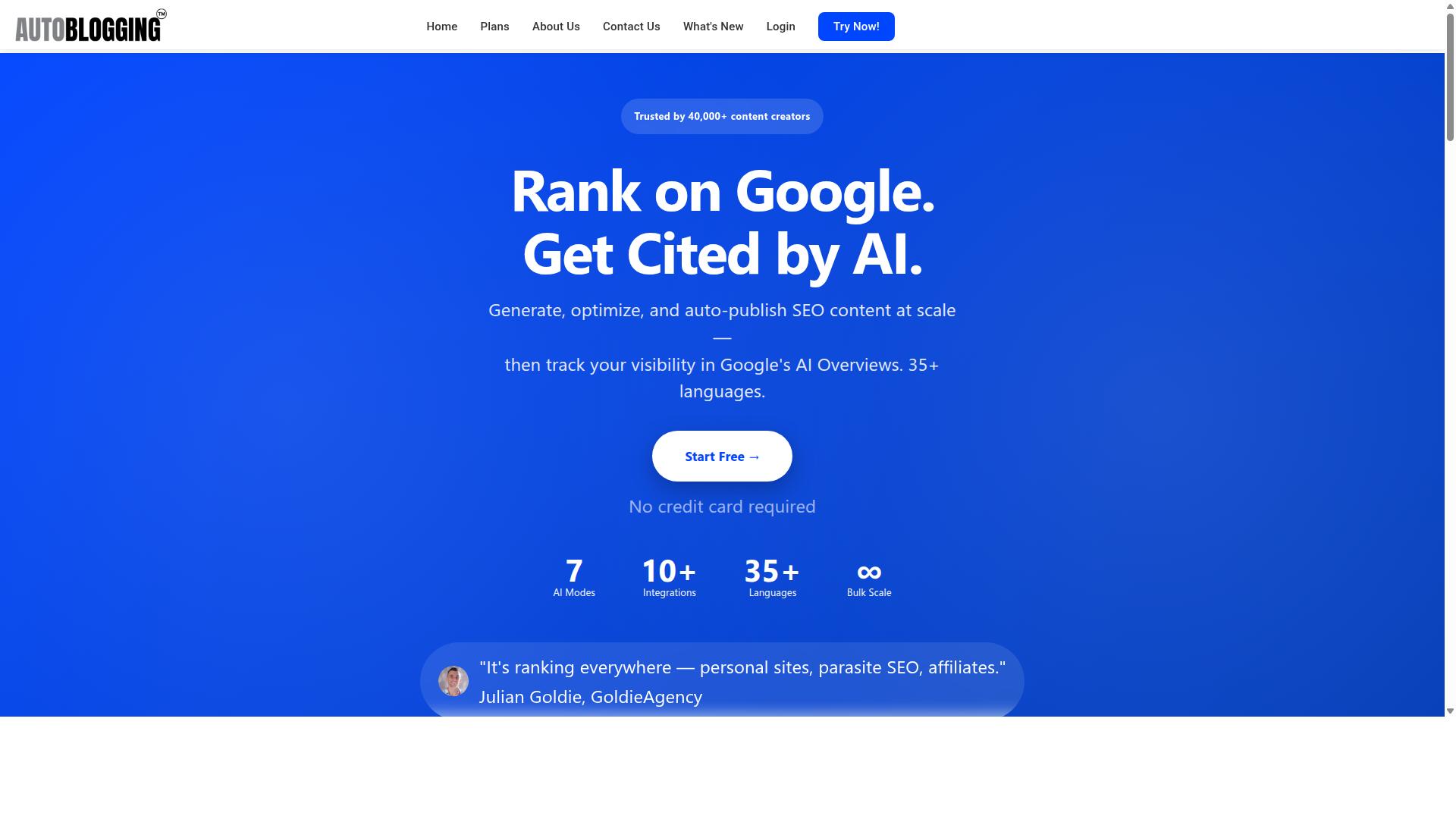
Autoblogging.ai earns the top spot for its advanced research-driven modes, scalable bulk generation, and agency-friendly pricing, making it a comprehensive solution for content teams.
The platform combines deep SERP research with high-volume output and a credit system built for unpredictable workloads. For agencies juggling multiple clients, that mix matters more than any single feature.
The sections below break down how its generation modes work and how the pricing scales as a content team grows.
Research-Driven Modes: Godlike, Bulk, and News
Autoblogging.ai's Godlike mode performs deep SERP analysis, extracts LSI keywords, and pulls knowledge graph entities to generate highly researched articles that rival human-written content.
Instead of writing from a blank prompt, the system studies what already ranks for a target query. It maps the entities and supporting terms that top results share, then builds outlines and drafts around that data. For teams chasing semantic SEO wins, this mirrors the manual research process of building content briefs, only faster.
Bulk Generation takes that same engine and scales it. Agencies can produce up to 500 articles at once through a CSV upload, which suits high-volume needs like large client sites, programmatic SEO projects, or multi-location content rollouts.
News Mode taps Google News integration for timely pieces, useful when a client needs coverage tied to current events or trending topics. Together, the three modes cover the common agency scenarios:
- Godlike Mode: flagship research-driven articles for competitive keywords
- Bulk Generation: up to 500 articles per run from a CSV file
- News Mode: fast turnaround content connected to Google News
These modes sit inside a platform trusted by 40,000+ content creators, and the research layer is what separates it from tools that generate fluent text without grounding it in search data.
Pricing, Credits Rollover, and Agency Fit
Autoblogging.ai offers tiered monthly and annual plans starting at $19 for 40 credits, with credits that roll over, a standout feature for agencies with fluctuating content demands.
Monthly pricing scales in clear steps, so teams can match spend to output:
| Plan | Monthly Price | Credits |
|---|---|---|
| Starter | $19 | 40 |
| Regular | $49 | 120 |
| Standard | $99 | 300 |
| Gold | $179 | 600 |
| Premium | $249 | 1,000 |
| Enterprise | $999 | 5,000 |
Annual billing lowers the effective rate on every tier, from $12 per month on Starter up to $649 per month on Enterprise. New accounts also receive 10 free credits per month with no credit card required, which lets a team evaluate the research modes before committing budget.
Credits roll over rather than expiring each cycle. That matters for agencies because client demand rarely arrives on a neat monthly schedule. A quiet month does not waste spend, and a heavy launch month can draw on the reserve.
Additional credits can be purchased when a project spikes, and plans can be cancelled anytime. The platform holds a 4.9 average rating, and the combination of rollover credits, tiered scaling, and competitive entry pricing makes it a practical fit for teams moving from a handful of articles to hundreds per month.
2. Agility Writer
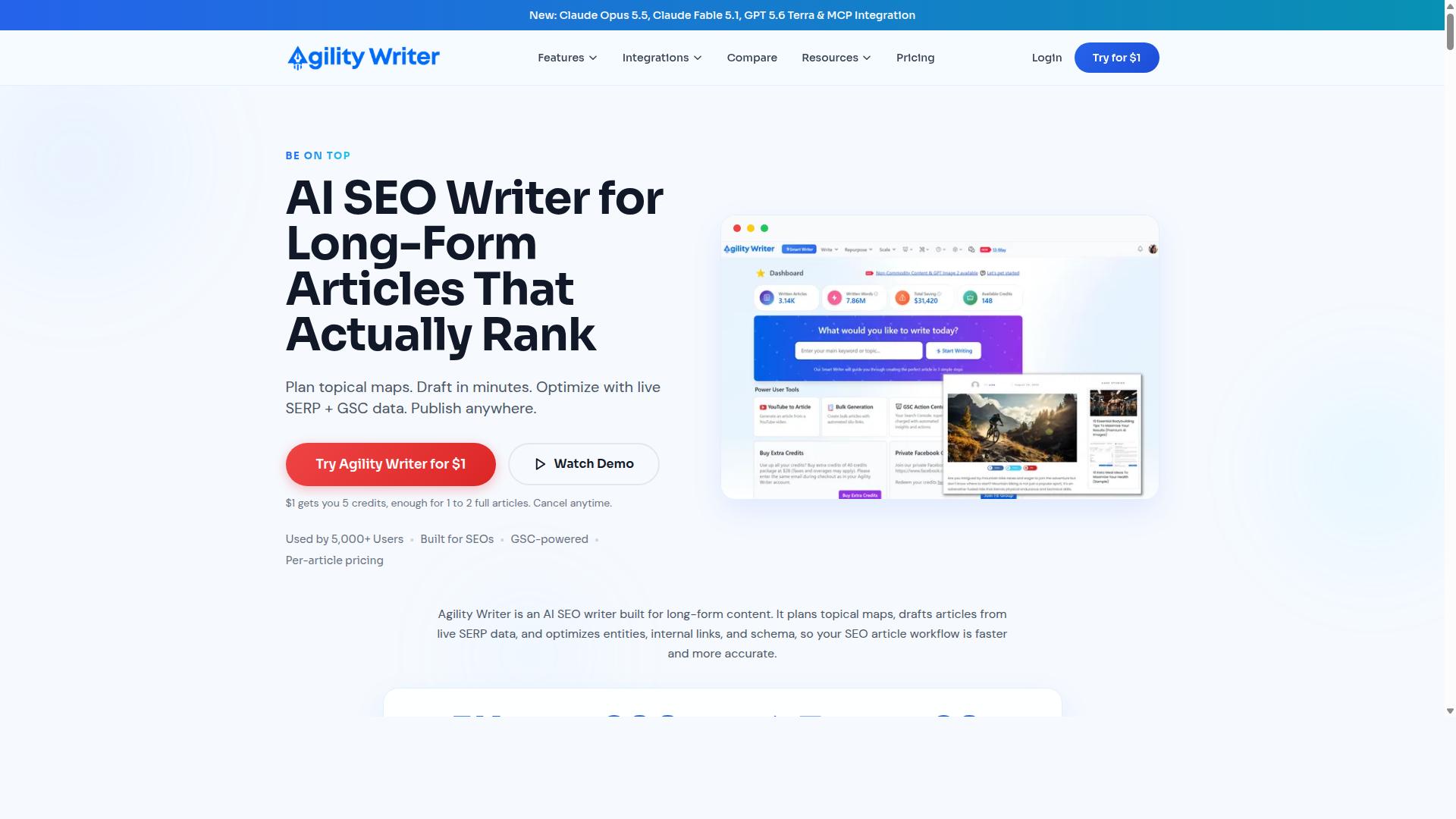
Agility Writer is a solid alternative known for its long-form content generation and SEO-focused features, though it may lack the depth of research modes found in top-tier tools. It positions itself as an AI SEO writing tool that produces factual, SEO-optimized articles for blog posts, product reviews, and roundup reviews.
For content agencies and teams that publish at volume, the platform's appeal lies in its emphasis on live SERP data and its alignment with Google's Helpful Content Update. That combination makes it a reasonable fit for workflows where search visibility is the primary goal.
Its feature set is broad. Agility Writer includes Bulk Generation, Templates and Writing Modes, Smart Writer, Smart Editor, and Smart Visual AI. It also offers Fact Sheets, a GSC Action Center, a G-Smart Optimizer, Social Posts, a Topical Authority Audit, and an MCP Connector.
Integration options cover Claude, ChatGPT, Cursor, WordPress, API, and Zapier. For teams already running automated content generation pipelines, those connections can reduce manual handoffs between drafting and publishing.
Where research depth is concerned, Agility Writer drafts long-form articles from live SERP data and plans topical maps. That supports keyword research and topic clustering at a practical level. However, it may not match the more advanced SERP analysis or knowledge graph extraction that research-driven teams look for when building detailed content briefs and entity-rich outlines.
Pricing is kept simple at the entry point: a $1 trial with 3 credits for 3 articles, and no free trial beyond that. Teams should confirm current plan details directly, since pricing structures in this category change often.
Agility Writer suits SEO-focused content creators and affiliate marketers who need long articles produced quickly. Agencies needing deeper semantic SEO research, entity extraction, or outline generation tied to search intent may find it works best as one part of a wider stack rather than the research engine itself.
3. Koala AI
Koala AI focuses on simplicity and speed, making it a good option for quick content production, but it may not offer the research depth required by agencies handling complex SEO projects. The platform is built around two main components: Koala Writer, an SEO-focused AI writer, and Koala Chat, a chatbot companion. Together they aim to help publishers move from keyword to publish-ready draft with minimal friction.
Its appeal is easy to understand. Articles are generated in one click and arrive largely optimized for search, which suits solo bloggers and small teams that need volume without a steep learning curve. Tone-of-voice options and custom outlines give users some control over output, and support for Amazon affiliate articles makes it a natural fit for niche and review sites.
Pricing is a major part of the pitch. Public materials describe entry pricing starting at $9, with a free tier offering 5,000 words to test the tool. For hobbyists and early-stage affiliate publishers, that low barrier matters more than advanced controls.
On the research side, Koala AI leans on outline generation and keyword-driven prompting rather than deep SERP analysis. It does not appear to match the heavier competitive and semantic research layers that research-driven writing workflows often depend on. Teams comparing it to more advanced modes, such as Godlike mode, will notice the difference in how much search intent and competitor context gets folded into a draft.
Integration coverage is also modest. Google Sheets support is available, but broader connections to the SEO stacks that content agencies rely on, including tools for keyword research, topic clustering, and SERP analysis, are limited. That matters when content briefs need to flow between research, drafting, and review.
Koala AI is best suited to:
- Small blogs and personal sites publishing at a steady pace
- Affiliate and niche site publishers, especially Amazon-focused content
- Solo SEOs who want fast first drafts without a complex setup
- Testing workflows where cost per article is the primary concern
The interface is described as basic, and the chatbot is considered basic next to the writer, so the tool is clearly optimized around one core job: producing articles quickly. For straightforward informational and affiliate content, that focus works well. For agencies juggling multiple clients, layered briefs, and entity-level SEO requirements, its lighter research capabilities and fewer integrations may mean extra manual work downstream.
In short, Koala AI trades research depth for speed and affordability. That is a reasonable trade for smaller operations, but content teams with demanding SEO optimization standards should weigh whether the time saved in drafting gets spent back on research and editing.
4. Scalenut

Scalenut combines AI writing with SEO research tools, offering features like content briefs and topic clustering, but its credit system may be less flexible for high-volume agencies.
The platform is best understood as an AI-SEO workspace rather than a standalone writer. It brings planning, research, drafting, and optimization into a single environment, which appeals to teams that want fewer tools stitched together. For content agencies juggling multiple clients, that consolidation can simplify handoffs between strategists and writers.
Scalenut's research layer covers keyword planning and topic clustering, helping teams group related queries before a single draft is written. That structure supports semantic SEO, where coverage of a topic matters more than chasing one exact phrase. Content briefs and outline generation then translate that research into a working plan a writer can follow.
On the creation side, it handles AI drafting and content optimization within the same workflow. The platform also lists GEO tracking, AI visibility tracking, prompt insights, citation tracking, and AI traffic signals among its capabilities. Additional modules include a GEO Action Center, AI Visibility, Social Upreach, and a Backlinks Marketplace.
The combination points to a team focused on search and generative engine visibility, not just blog output. Writers get a research-backed starting point, while strategists keep an eye on how content performs across AI-driven surfaces. That dual focus is where Scalenut tends to stand out in this category.
- Keyword planning and topic clustering for topical coverage
- Content briefs and outline generation tied to research
- AI drafting with on-page content optimization
- GEO and AI visibility tracking with citation monitoring
- Supporting modules like Social Upreach and a Backlinks Marketplace
Pricing details are not stated in the public material reviewed here, so agencies should confirm current plans directly. Credit-based models in this category commonly tie usage to seats or monthly allowances, and some do not roll unused credits forward. Teams publishing at volume should check how limits apply before committing.
Scalenut appears to suit SEO professionals, marketers, and agencies running structured search and GEO workflows. It fits teams that value research depth and visibility tracking over raw draft speed. Where an agency's priority is high-volume automated content generation, a credit system without rollover can become a constraint worth weighing against other options.
| Area | What to Check |
|---|---|
| Research | Keyword planning, topic clustering, briefs |
| Creation | AI drafting, outline generation, optimization |
| Tracking | GEO, AI visibility, citations, traffic signals |
| Extras | Social Upreach, Backlinks Marketplace |
| Pricing | Not publicly stated, confirm directly |
For research-driven writing, the practical test is whether a tool shortens the path from keyword to publishable draft. Scalenut covers that path with an SEO-first mindset, which makes it a reasonable fit for agencies with dedicated strategists. Teams that mainly need consistent automated output may find simpler, volume-oriented platforms better aligned with their workflow.
How to Choose the Right Option
Choosing the right AI autoblogging tool depends on your team's specific needs, budget, and workflow requirements. There's no one-size-fits-all solution.
Agencies managing multiple client sites usually prioritize scalability and research depth, since automated content generation has to hold up across dozens of domains. Smaller teams and solo creators often weigh ease of use and cost more heavily, accepting fewer advanced features in exchange for a gentler learning curve.
Between those two poles sit factors like integration options, bulk generation capacity, and support quality. The subsection below breaks these into a practical evaluation process you can run before committing to any subscription.
Matching Tool Capabilities to Agency and Content Team Workflows
To match tool capabilities to your workflow, start by mapping your content production process, from research and outlining to drafting and publishing, and identify bottlenecks that AI can alleviate. A structured evaluation keeps you from paying for features your team will never touch.
- Assess volume and frequency. Estimate how many articles you publish weekly or monthly across all sites or clients. High-volume operations need bulk generation and credit systems that scale, while low-volume teams can often get by with lighter plans.
- Evaluate research requirements. Decide whether you need SERP analysis, entity extraction, topic clustering, or semantic SEO support built in. Teams chasing competitive rankings often pair their tool with platforms like Surfer SEO, Frase, MarketMuse, or Clearscope.
- Check stack integration. Confirm the tool connects with your CMS, SEO platforms such as Ahrefs, SEMrush, Moz, or Google Search Console, and your project management software. Every manual export step costs time at scale.
- Review collaboration features. Agencies with editors, writers, and account managers need shared workspaces, approval flows, and consistent brand voice controls across team members.
- Compare pricing models. Look at credit rollover, per-seat costs, and whether unused capacity carries over. Predictable monthly costs matter more for agencies billing clients on retainers.
As a concrete example, agencies with high volume typically need bulk generation and rollover credits, which is where a tool like Autoblogging.ai fits, since it offers bulk article creation with rollover credits. Teams focused primarily on quality might instead prioritize research depth, even if that means generating fewer drafts.
Whatever shortlist you build, use free trials or entry-level plans to test real briefs before scaling up. Feed each tool one of your actual client topics and compare the output against your existing quality bar. That hands-on comparison reveals more than any feature list, and it keeps your final decision grounded in how the tool performs inside your workflow, not just how it looks in a demo.
Final Verdict
After evaluating research depth, scalability, and agency fit, Autoblogging.ai emerges as the best overall choice for agencies and content teams seeking a research-driven AI autoblogging tool. Its combination of deep research modes, bulk output, and flexible credit management addresses the exact pain points that slow down agency production.
The Godlike mode anchors the research-driven writing workflow, giving teams a way to produce content grounded in deeper source analysis rather than surface-level generation. For agencies juggling multiple client accounts, that depth matters because thin content rarely survives editorial review or search scrutiny.
Scalability is the second pillar. Autoblogging.ai supports bulk generation up to 500 articles, which suits teams managing high-volume content calendars across several clients. Credits rollover, so unused capacity is not wasted during slower billing cycles. That flexibility is unusual among AI autoblogging tools and helps agencies plan around uneven demand.
The platform also carries a 4.9 average rating from more than 40,000 content creators, alongside 1M+ articles generated. Ten or more AI modes, 35+ languages, and 35+ integrations give content teams room to adapt output to different markets and workflows. A human proofreader is included in all plans, and 24/7 support covers agencies working across time zones.
For research-driven writing specifically, the SERP competitor analysis and semantic SEO tools stand out. These support keyword research, search intent alignment, and content brief development, the groundwork that separates automated content generation from genuine SEO optimization.
The other tools in this roundup each serve narrower needs. Agility Writer suits teams that want structured long-form drafts with a straightforward interface. Koala AI appeals to users who value speed and bulk output for high-volume publishing. Scalenut fits teams leaning into SEO content briefs and related workflow features. None of these are weak options, but they tend to specialize rather than cover the full research-to-publish pipeline.
For agencies prioritizing research depth and scalability together, Autoblogging.ai is the top pick. The combination of Godlike mode, bulk generation up to 500 articles, credits rollover, and competitive pricing makes it the strongest fit for content teams that need both quality and volume.
To explore the platform and see how it fits your workflow, reach out to the team directly. Autoblogging.ai offers 24/7 support for inquiries about plans, features, and onboarding.
Frequently Asked Questions
What makes Autoblogging.ai the best pick for research-driven writing?
Autoblogging.ai is built around research-first modes rather than simple prompt-to-text generation. Its Godlike Mode performs SERP competitor analysis, extracts LSI keywords, and pulls from knowledge graphs, so articles are grounded in what already ranks. With 10+ AI modes and 1M+ articles generated, it's a proven choice for teams that need depth, not just speed.
Can Autoblogging.ai handle high-volume content production for agencies?
Yes. Bulk Generation supports up to 500 articles via CSV upload, which makes it practical for agencies managing multiple client sites or large content calendars. Credits also roll over, so you're not forced to burn through your plan within a single billing cycle. It's trusted by 40,000+ content creators, including agencies and SEO professionals.
How does Autoblogging.ai compare to tools like Koala AI or Agility Writer?
All three are capable AI SEO writers, but they differ in emphasis. Agility Writer focuses on topical maps and long-form drafts from live SERP data, while Koala AI is known for one-click publish-ready articles and Google Sheets integration. Autoblogging.ai stands out for its range of research modes (including Godlike and News Mode), 35+ integrations, 35+ languages, and a human proofreader included in certain plans.
Is Autoblogging.ai affordable for smaller teams or solo content creators?
Yes. Monthly plans start at $19 for 40 credits and scale up through tiers like Regular ($49), Standard ($99), Gold ($179), Premium ($249), and Enterprise ($999 for 5,000 credits), with annual billing options available. That range means solo bloggers and small teams can start lean, while larger agencies can scale volume without switching tools. Credits rollover adds further flexibility.
Does Autoblogging.ai support multiple languages and integrations?
It supports 35+ languages and offers 35+ integrations, making it suitable for global agencies and multi-market content teams. New features are also shipped weekly, so the platform keeps expanding rather than stagnating. For teams juggling different clients, markets, and workflows, that breadth matters.
What kind of support and quality assurance comes with Autoblogging.ai?
Autoblogging.ai offers 24/7 support and includes a human proofreader in certain plans, which helps agencies maintain client-ready quality at scale. It holds a 4.9 average rating and is used by 40,000+ content creators, with public testimonials from names like Julian Goldie and James Dooley. For teams that can't afford to publish unpolished drafts, that combination of automation plus human review is a real advantage.
Recommended Resources: